


Are Supersonic Commercial Flights Coming Back?

The U.S. is lifting its 52-year ban on supersonic flight over land. With Boom Overture on the horizon, here's what the return of supersonic travel means for commercial aviation.
The Concorde Era
From 1976 to 2003, the Concorde revolutionized air travel with supersonic passenger service. It was essentially a 100-seat fighter jet at the edge of the atmosphere: Mach 2.02 cruise at FL580, where passengers could see the curvature of the Earth and the sky above shifted from deep blue to near-black.
Only 376 pilots were ever qualified to fly the Concorde — fewer than the total number of humans who have been to space.
The cockpit was a steampunk symphony of analog dials — 365 switches and gauges at the flight engineer's station alone.
Kinetic heating at Mach 2 stretched the aluminum fuselage by up to 12 inches, opening a narrow seam beside the flight engineer's panel — wide enough for a pilot to tuck in a pen. When Concorde decelerated and the metal cooled, the gap closed, sealing the pen inside the airframe forever.
A controller in the cockpit allowed the visor to be retracted and the nose to be lowered to 5° below the standard horizontal position for taxiing and take-off.

As Captain Mike Bannister, one of Concorde's most celebrated commanders, put it:
"Twice as fast, twice as high, and twice as many things to do."
Concorde revolutionized Atlantic travel by bridging London/Paris and New York/Washington in roughly 3.5 hours at Mach 2 — but burned fuel at 91.5 tonnes per hour. Ticket prices reflected that reality. The passenger base was exclusively ultra-premium — a market that simply wasn't large enough to sustain a full commercial program at scale.
But perhaps the most underappreciated constraint was geographic. A blanket ban on civil supersonic flight over U.S. land, in place since 1973, meant Concorde was permanently restricted to oceanic routes. The aircraft that could fly anywhere in the world faster than any other was barred from flying over most of it.
Read this post to learn more about Atlantic oceanic routes: NAT-HLA Explained: The North Atlantic Airspace
Then, on October 24th, 2003, the last Concorde landed at London Heathrow. Following a long safety record, a crash on July 25, 2000, in Paris, combined with the post-9/11 downturn and high operating costs, led to the end of supersonic commercial flights era. And for 22 years, the skies went quiet above FL500.
Now, they're about to get loud again.
The Regulatory Wall Just Cracked
In June 2025, President Trump signed an Executive Order directing the FAA to repeal the prohibition on overland supersonic civil flight within 180 days — provided no audible sonic boom reaches the ground.
In March 2026, the House of Representatives passed the Supersonic Aviation Modernization Act (SAM Act, H.R. 3410), which would codify those changes into law. Senate passage is still pending, but the regulatory trajectory is clear.
This is not a minor procedural update. It is the dismantling of a 52-year wall that fundamentally constrained what supersonic aviation could be.
The key phrase in both the Executive Order and the SAM Act is "no audible sonic boom at ground level." That condition didn't exist in the Concorde era — the technology to suppress the sonic boom simply wasn't there.
Today, it is. Boom Supersonic calls their implementation Boomless Cruise: a combination of aircraft design, altitude, and flight profile management that prevents the shock wave from reaching the surface at audible levels.
If it works at commercial scale, it unlocks a category of routes the Concorde could never touch — transcontinental supersonic flight over populated land.
The Overture Program: Where Things Actually Stand
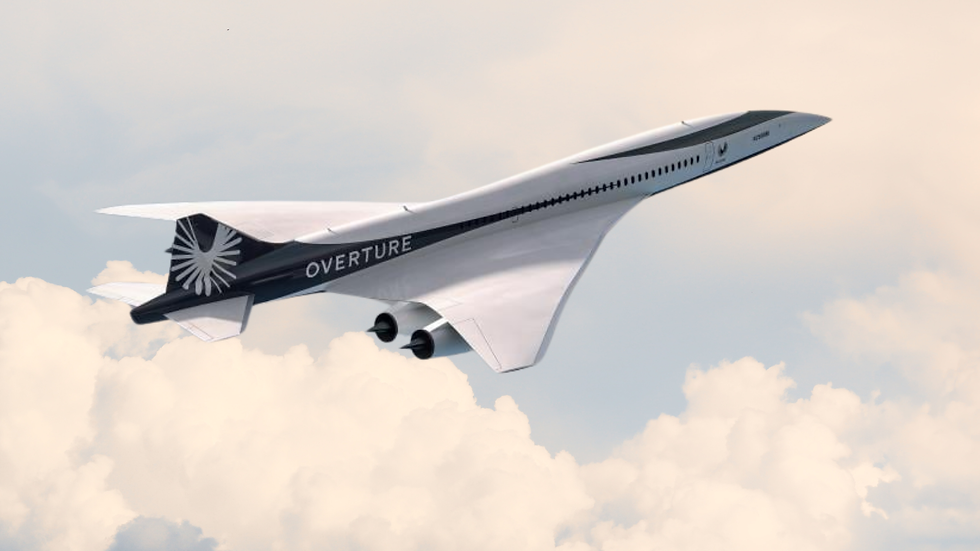
Boom Supersonic's flagship product is the Overture — a 65-80 seat supersonic airliner targeting Mach 1.7 cruise at approximately FL600. It is a clean-sheet design with a different mission profile, with a new regulatory environment to navigate.
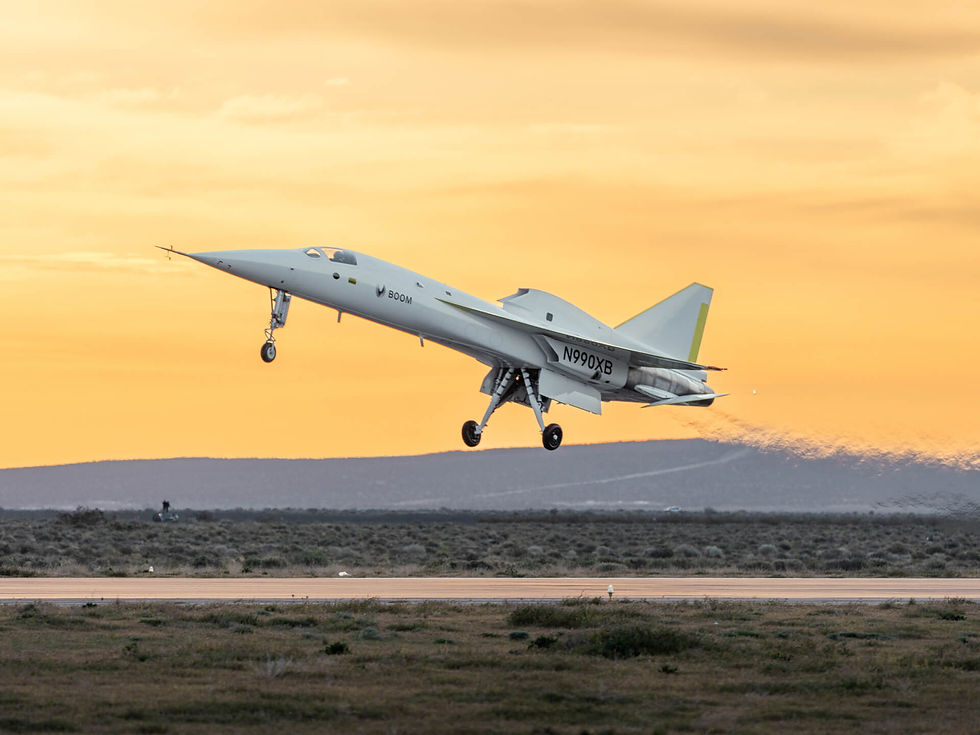
Here is the verified status of the program as of April 2026:
The XB-1 demonstrator — a one-third scale supersonic proof-of-concept — completed its first supersonic flight on January 28, 2025, followed by a second on February 10, 2025. Its purpose was to validate the aerodynamic and propulsion concepts. That validation is now done.
The Symphony engine — Boom's proprietary powerplant, developed in-house — is expected to begin testing in 2026. Certification of a clean-sheet engine alongside a clean-sheet airframe is one of the most complex regulatory processes in commercial aviation.
Overture Roadmap:
Overture prototype rollout: targeted for 2026.
First flight: targeted for 2027.
FAA type certification: Boom targets end of the decade. Independent analysts, including Forecast International, believe the realistic timeline extends into the early 2030s.
The order book stands at approximately 130 aircraft:
United Airlines — 15 firm orders + 35 options
American Airlines — 20 orders + 40 options
Japan Airlines — 20 pre-orders
These are signed commercial agreements from three of the world's largest carriers. They are not letters of intent. The demand signal from the industry is real.

What This Means for Long-Haul Aviation
New York to London: 3.5 hours (vs. 7 hours subsonic)
Los Angeles to Tokyo: ~6 hours (vs. 11-12 hours subsonic)
New York to Los Angeles: under 2.5 hours (a route Concorde could never fly commercially)
The geographic constraint that killed Concorde commercially is now, potentially, gone. And that changes the entire math of where supersonic makes sense.
In the Concorde era, the only viable supersonic routes were transatlantic — purely because overland restrictions eliminated everything else. With Boomless Cruise and a lifted overland ban, the route map expands dramatically.
The initial market will be premium. Supersonic is not, and will not be for the foreseeable future, a mass-market product. The economics point clearly toward business and ultra-premium tickets. The disruption to the long-haul market won't be in volume.
For airlines, the strategic question is fleet positioning. The carriers with Overture on order are placing a bet that there is a sustainable premium market for speed. The carriers without orders are betting those economics don't work. History will judge one of them right.
The Reality Check: Fuel, Cost, and Sustainability
Speed has its cost. At Mach 1.7, the Overture will burn approximately 7 times more fuel per seat than economy class on a comparable subsonic route, and 2–3 times more than a business class seat. Those numbers are not disputed by Boom — they are the cost of flying supersonic.
Boom's answer is 100% SAF (Sustainable Aviation Fuel). The Overture is designed from the ground up to operate exclusively on SAF, which would theoretically offset the carbon differential through its production process.
There is a significant challenge with this answer: SAF at the scale required for commercial supersonic operations does not yet exist. Current global SAF production covers a fraction of total aviation fuel demand. Building the production capacity to supply a commercial supersonic fleet — even a small one — alongside the existing demand is a challenge that goes well beyond Boom's engineering team.
With jet fuel prices already at historically elevated levels — driven in part by Middle East tensions affecting global supply chains — the operating economics of supersonic are under pressure before a single Overture has flown a commercial passenger.
Read a comprehensive analysis about the current fuel crisis in the post:
This is the open question the industry cannot yet answer: at what ticket price does supersonic become viable, and is there a large enough premium market to sustain that price?
A New Kind of Flying Experience
For the pilots who will eventually fly the Overture, this is not simply a new type rating. It is a categorically different operating environment.
Supersonic cruise management will certainly require a different kind of management. ATC separation standards for supersonic traffic in cruise airspace are not yet defined for the modern environment. New contingency procedures, new energy management strategies, and new regulations will need to be developed, certified, and trained.
The pilots who fly the Overture in the 2030s will form a very specific professional community. Like the 376 who flew Concorde, they will operate in a category that very few ever had the opportunity to experience. Logging supersonic flight hours on the logbook will certainly have a special meaning for any pilot.
The Bottom Line
The return of commercial supersonic flight is no longer a concept. It is a funded program, with signed airline orders, a demonstrated supersonic prototype, and a regulatory framework moving — for the first time in half a century — in its favor.
The timeline is real but demanding. The economics are challenging but not impossible. The technology is closer than it has ever been.
What happens next depends on whether Boom can certify a clean-sheet engine and airframe simultaneously, whether SAF supply can scale fast enough to make the environmental case credible, and whether premium passenger demand proves deep enough to sustain the operating economics of flying at the edge of the atmosphere.
The flight levels that went quiet in 2003 are about to get interesting again.
The next era of long-haul aviation is coming — and it's coming fast. Start with Wader Pilot Logbook for FREE today at logbook.waderaviation.com and make sure your professional record is ready for whatever comes next. Rest assured that we're already preparing a supersonic flight time field for your logbook ;)


Comments